T
J

Buddha
Smriti Park
Museum
The Great Passing: Large Narrative Mural
This large narrative mural in papier mache depicts scenes related to the Buddha’s passing or the Mahaparinirvana.

Buddha Smriti Park features three main architectural spaces, the Stupa, the Meditation Centre and the Buddha Smriti Museum. While each is an experience in its own right, together they form a unified and complementary experience of the Buddha Smriti Park complex as a whole.
In addition to interpreting the life and legacy of Buddha, the museum acts as an orientation to the entire complex. Visitors not only gain a better understanding of the legacy of Buddha’s teaching and the continued relevance of Buddhism as one of the world’s great religions but also learn about the Karuna Stupa at the heart of Buddha Smriti Park. They are also be invited to make use of the park regularly, whether to picnic with family and friends, walk the peaceful grounds or perhaps returning to spend time in one of the meditative cells at the park’s Meditation Centre.
The word Smriti, meaning memory or remembrance, alludes to the importance of memory in building the future. Before there was Buddha Smriti Park there was a prison site.
But, long before there was a prison, there was Buddha, his journey, his trials and his triumphs. Although the prison no longer exists, the memory of it reminds visitors of the Buddhist belief that suffering is part and parcel of attachments to the material world. Similarly, the wondrous transformation of the park and site is a recovery of the distant past, the remembrance of Buddha, his teachings and the glory of ancient Bihar. Thus, as with the cycle of birth, death, and rebirth, the recent past diminishes as the distant past re-emerges.
At the Buddha Smriti Museum, the remembrance of times past converges with the present as visitors discover and rediscover Buddha’s life, his teachings and his travels in ancient Bihar.
"It is better
to travel well than to arrive"
Lord Buddha
Special Treatures Gallery:
Buddhist artifacts from Tibet and Ladakh.
The concept:
Lord Buddha and the Path to Enlightenment.
This concept statement served to highlight that the path to enlightenment is a journey – taken and discovered by Buddha and his subsequent followers. Visitors to Buddha Smriti Museum are invited to explore the Buddha’s life-story, touching on key milestones, and to appreciate the resulting legacy that continues to endure.
From this initial concept statement was further developed an interpretive framework, which guided the exhibition design and served to orchestrate a meaningful and memorable experience for visitors to Buddha Smriti Park.

I Got the opportunity to work on this project as a Designer at Lord Cultural Resources. I was involved with the concept development, interpretive planning, tendering, project management and site supervision.
The project offered various opportunities as an industrial designer and architect to merge contemporary designs with traditional vocabulary. It also posed significant challenges in terms of historical research, content development, working with nascent museum fabrication industry in India along with working in collaboration with traditional, contemporary artists and craftsmen to create an exhibition which was based more on commissioned pieces rather than being a collection based one.
The
Interpretive
Parameters
Gallery Size: The total available exhibition space for the Buddha Smriti Museum was 1486 square meters (16,000 square feet).
This was the total space available within the museum for orientation and exhibition experiences.
Visitors enter the museum via the meditative garden and exit through the Hall of Light facing the Buddha Smriti Park site and Stupa.
The key objectives for the Buddha Smriti Museum Exhibition are:
Behavioral:
the exhibition visitors are motivated to explore the rest of Buddha Smriti Park and learn more about the life and legacy of the Buddha.
Emotional:
after experiencing the exhibition at Buddha Smriti Museum, visitors should feel inspired by the life and legacy of the Buddha and his teachings.
Learning:
Visitors should learn about the key events in the Buddha’s life; they can understand that the Buddha’s teachings had a profound impact on India and the world and about the key Pilgrimage sites in Bihar where the Buddha had traveled; visitors also learn about the Buddha Smriti Park site and its transformation.


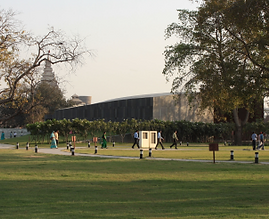
The remnants of the jail, the Karuna Stupa and the museum building at the Buddha Smriti Park Site.

"With our thoughts we make the world."
Lord Buddha

Orientation experiences prepare visitors for the exhibition experiences that follow. They are spaces that help visitors to physically and intellectually transition from non-museum related spaces to the interpretive spaces of the museum. Under the rubric of orientation experiences we have the following: • Meditative Sculpture Garden; • Pre-Theatre Exhibit; • Orientation Theatre Experience, and; • Buddha Smriti Park Orientation.

This gallery explores the early life of Prince Siddhartha Gautama. As visitors move through the space they encounter beautifully executed narrative murals depicting key scenes in the life of the Buddha. The experience is largely aesthetic, utilizing narrative wall paintings like those found in the Ajanta Caves of Maharashtra to visually tell the story of the Buddha’s life. Supplementing these visual narratives are newly created miniature paintings and a limited number of graphic panels.

As visitors exit the Buddhist Cave and the exhibition galleries they enter into the Hall of Light. Located in the Hall is the Buddha Smriti Park Orientation exhibit. From the Hall through the existing bank of windows, visitors see the beautiful park unfold, beckoning them to walk, explore and think about what they have just experienced. Included within the Hall of Light is a final gesture – a series of seven large scale terracotta murals
Orientation experiences prepare visitors for the exhibition experiences that follow. They are spaces that help visitors to physically and intellectually transition from non-museum related spaces to the interpretive spaces of the museum. Under the rubric of orientation experiences we have the following: • Meditative Sculpture Garden; • Pre-Theatre Exhibit; • Orientation Theatre Experience, and; • Buddha Smriti Park Orientation.
The Galleries
The exhibitions at Buddha Smriti Museum interpret the story of the Buddha’s life, his journey to Parinirvana, his legacy and the subsequent flourishing of Buddhist philosophy and practice around the world. This museum is unique. Rather than a strict adherence to historical facts (of which there is a dearth of information) or pure exploration of myth and legend that surrounds the Buddha’s life (of which there is much debate) it was decided to meld the two – to walk the “middle path” so to speak, between “the Buddha of history” and the “Buddha of story”.
This approach recognizes Bihar as important to the history of Buddhism and also allowed us to celebrate the richness and diversity of Buddhist practices and traditions. The galleries were conceptualized to be thematically organized according to the following structure:
A loose chronology was also incorporated so as to convey to visitors the notion of the Buddha’s journey and spiritual growth. As visitors progress through the galleries they are invited to become fellow travelers on the journey to Enlightenment and will learn about the life of Buddha through various arts, crafts and depictions found in Bihar, India and other Buddhist nations.

The miniature painting stand accompanying each large mural, the miniature paintings describe the story surrounding each major life even. The stand has a movable magnifying glass to carefully view the intricate details.

The meditative sculpture garden is the first museum area that visitors encounter. This quiet and peaceful space serves as a physical and psychic break from the streets of Patna just beyond the Buddha Smriti Park gates. Visitors are greeted by the green of plants, and the cool shade they offer. Benches are provided so that visitors may linger and rest for a moment to admire the Buddha sculpture which adorns the garden.

The seven terracotta murals in the hall of light depicting the seven weeks of Lord Buddha after enlightenment.
The miniature painting stand accompanying each large mural, the miniature paintings describe the story surrounding each major life even. The stand has a movable magnifying glass to carefully view the intricate details.

The journey through the exhibition presents visitors with a play of different light qualities. Upon entering the Museum from the Meditative Sculpture Garden, visitors pass through the Pre-Theatre exhibit to the Orientation Theatre – a journey from light into the darkness that prepares visitors for the experience to follow.
Progressing into the main exhibition space, the light levels gradually increase with soft glows that emanate from display cases and interactive units. The transition between galleries is highlighted by rays of light that emphasize one’s journey between places. At the core of the experience is the Special Treasures Gallery which is dimly lit as it houses delicate and sensitive artifacts.
Upon leaving the Buddhist Cave, visitors enter the Hall of Light, an inspiring space that is flooded with natural light from-to-ceiling windows. From here, visitors can enjoy direct sightlines towards the Karuna Stupa as they reflect on their experiences in the museum.
The material palette throughout is muted, raw and natural, including stone, wood and metal. These materials are layered with a dramatic; drawing inspiration from the Buddhist concept of impermanence, the gallery experience feels dream-like and transient.
The Buddhist Cave is another place of dim lighting. The idea was to enable visitors to meditate on their other bodily senses rather than their visual senses alone. Accentuated by ambient vocal Buddhist Shlokas and projection of texts from ancient rock edicts it was conceived to be a place of contemplation.


Terracotta Mural in the making
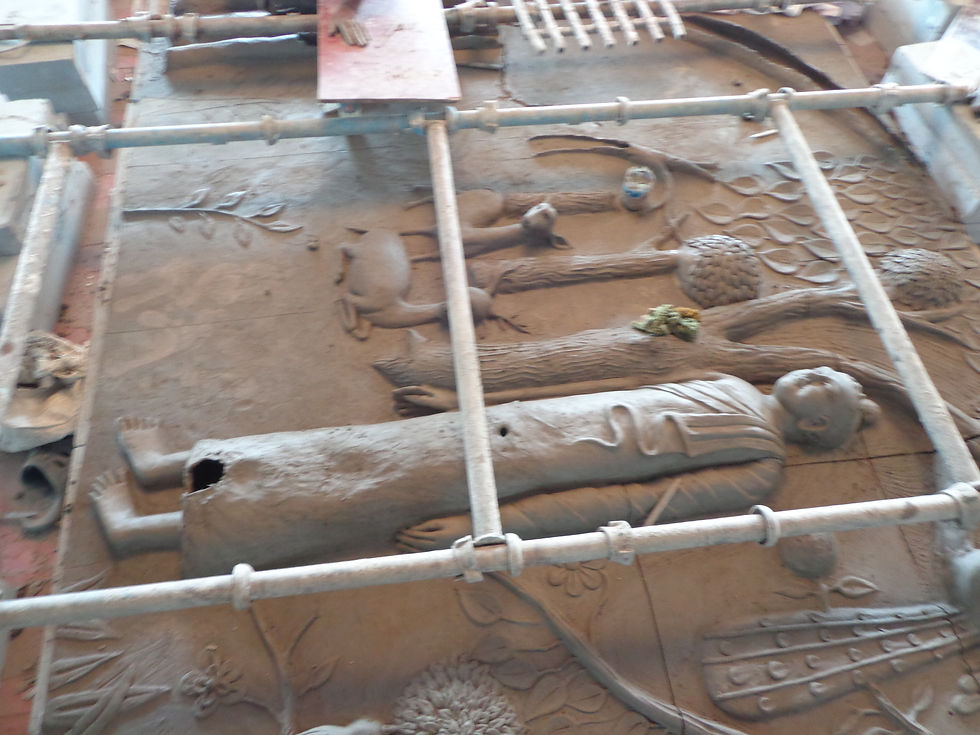
Terracotta mural in progress

Large papier mache mural in the making.
Terracotta Mural in the making
Various art pieces and murals were commissioned in local and contemporary styles.
Local crafts techniques like Madhubani Paintings, Sikki - Grass Weaving Techniques, Pattachitra - Painting on leather, Papier Mache, Terracotta Mural etc. were used to depict different scenes and stories of Gautama Buddha's life. All these were commissioned from prominent local craftsmen and nationally acclaimed artists.
Browse Other Projects
SOCIAL GAMEPLAY - DREAM11
Strategy and product design of a Social Gameplay ecosystem on Dream11, a fantasy sports platform.

SIX NOTES FOR SMART CITY FUTURES
To draw out the contours of what the "smart city" is and could become, we offer six core notes by which the “expressive, cognitive, and imaginative possibilities” of the city in the age of data may be realized.

EVOMO RESEARCH & ADVANCEMENTS PVT. LTD.
A tech. startup aimed at developing a disruptive, affordable and safe transportation for rural areas.

GREENING BURJ KHALIFA
Conceptual design on how to turn skyscrapers into sustainable and zero waste buildings using natural systems.

TSYS - PRIME
Redesign of a customer services application used my major banks and credit card companies across the world.


BUDDHA SMRITI PARK MUSEUM
A museum dedicated to Lord Buddha, his life, teachings & Buddhism itself.

RETAIL & FIXTURE DESIGN
Layout, fixture design and production supervision of retail and flagship stores for different brands.

CUBEY
“CubeY” is an innovative furniture system, deriving its name from its unique joinery.

PRE-MATCH LIVE ACTIVITY (iOS)
POC and Phase 1 of on Dream11 during IPL and T20 World Cup 2024, focusing on user engagement before the start of the match

PALAVA EXPERIENCE CENTER
A directed and linear visitor experience designed to educate visitors about evolution of urban settlements and livability factors.

ARCHITECTURAL PERCEPTION AND MOBILITY
An attempt at understanding our urban and built fabric; its beauty through the eye of a visitor or an inhabitant in transit.

BOOKWALK
A bookshelf inspired from a human form in motion.
